Choosing a printing method for custom mugs is not simply a question of which technique produces the brightest image.
For wholesale buyers, the right decoration process depends on the mug material, artwork, order quantity, expected use, and the supplier's actual manufacturing capabilities.
Sublimation is generally worth considering for photographic or multicolour designs on compatible polymer-coated mugs. Screen printing and related ceramic decoration methods may be better suited to certain repeat logo designs, spot colours and production programmes.
But there is an important distinction: suppliers do not always use the term "screen printing" to describe the same finished process.
Some ceramic decorations involve fired transfers, while others involve surface-applied inks and different curing systems. These are not automatically equivalent in durability, appearance or cost.
Before requesting quotations, buyers should also clarify whether they need blank sublimation-ready mugs or mugs already printed with their artwork.
This guide explains the practical differences, important limitations and specification questions to resolve before sampling or bulk ordering.
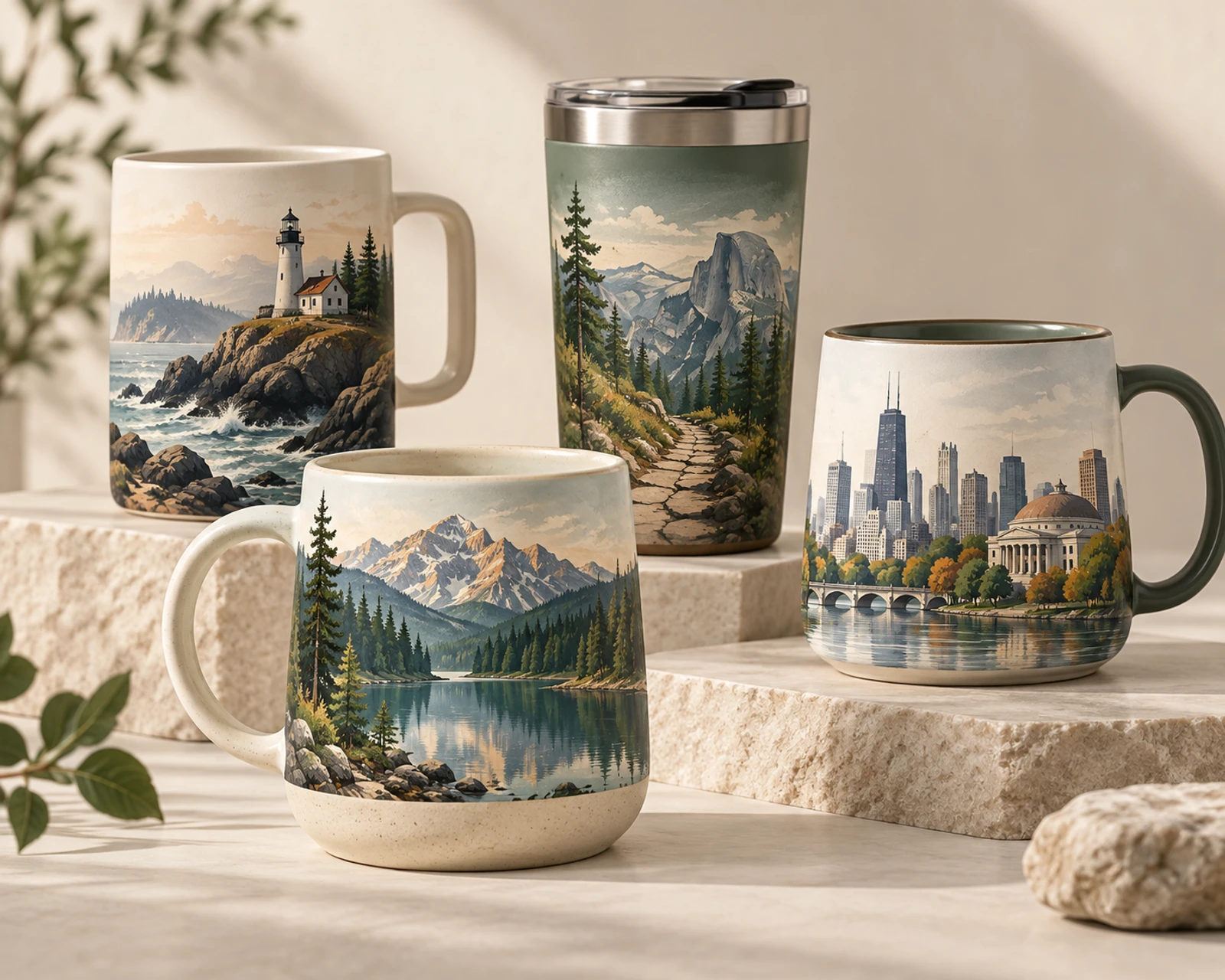
1. First Decide: Blank Mugs or Finished Printed Mugs
The first question should come before any discussion about printing methods: are you buying blank mugs to decorate yourself, or finished mugs with your design already applied?
A blank sublimation-ready mug and a fully decorated custom mug are different purchasing requirements.
Blank sublimation-ready mugs may be supplied with a compatible coating but without artwork. The buyer or another decorator applies the design later.
Finished sublimated mugs have the artwork transferred onto a compatible coated surface by a decoration provider.
Finished screen-printed mugs may involve another printing or transfer process, with specific ink, curing and handling requirements.
A supplier quotation should clearly distinguish these products. For example, a request for 50 sublimation mugs does not by itself establish whether the buyer wants 50 printable blanks or 50 finished products. Confirm the intended deliverable before comparing prices.
2. How Sublimation Works on Ceramic Mugs
Dye sublimation uses specialized inks and heat to transfer artwork onto a compatible surface. For ceramic mugs, the decoration normally requires a polymer coating designed to accept sublimation dyes.
The design is printed onto transfer paper and placed against the mug using a suitable transfer arrangement. Heat allows the dye to enter the compatible coating.
Sublimation does not mean that ordinary ceramic glaze automatically accepts the ink. An uncoated ceramic mug is not interchangeable with a sublimation-ready mug. The coating, blank quality, mug geometry, press equipment and processing settings all influence the finished result.
Where sublimation can work well
Sublimation can be a useful option for:
- Photographic destination artwork
- Detailed character illustrations
- Multicolour souvenir designs
- Personalised names or artwork
- Designs with gradients
- Certain wraparound layouts
- Smaller production programmes where supported
However, the exact printable area depends on the mug shape and the supplier's equipment. A digital image covering an entire mug in a mockup does not guarantee that the same area can be decorated in production.
Important material limitations
Conventional dye sublimation does not provide an opaque white ink layer. White design areas normally rely on the underlying printable surface. For this reason, many sublimation programmes use white or light-coloured compatible substrates.
Ask the supplier for the exact coating and blank specification, especially when considering dark-coloured mugs, unusual finishes or non-ceramic materials.
3. What Does Screen Printing Mean for Custom Mugs?
Screen printing is often associated with reproducing logos and graphic designs using prepared screens. In drinkware sourcing, however, buyers should confirm exactly how the decoration reaches and remains on the mug.
A supplier may offer:
- Direct screen printing with an appropriate ink and curing process
- Screen-printed ceramic transfers or decals
- Fired ceramic decoration
- Another specialised decoration method
These processes should not all be described as the same manufacturing treatment. For example, a screen-printed ceramic decal that undergoes an appropriate firing process differs from a surface print cured under another system.
Buyers should ask for the actual decoration process rather than assuming a description such as "screen printed" proves kiln firing or a particular durability level.
Where screen-based decoration may work well
Depending on the selected process and supplier capability, it can be suitable for:
- Simple logos
- Bold artwork
- Limited spot-colour designs
- Repeating souvenir collections
- Corporate merchandise
- Larger programmes with consistent artwork
Artwork detail, colour count, print positioning and the selected mug surface can affect feasibility. Do not assume that every screen-printing process can reproduce photographic gradients or full wraps in the same way as sublimation.
4. Sublimation vs Screen Printing: Buyer Comparison
Compare the actual specified substrate, decoration method and finished article rather than the printing label alone.
| Buying consideration | Sublimation | Screen printing / ceramic decoration |
|---|---|---|
| Typical artwork | Photographs, gradients and detailed multicolour illustrations | Often suitable for bold logos and controlled spot-colour graphics |
| Compatible surface | Requires an appropriate sublimation coating | Depends on ink, transfer, firing or curing method |
| White elements | Usually rely on the substrate colour | Depends on available inks and process |
| Artwork setup | Digital artwork and suitable transfer preparation | May require screen separations, spot colours or transfer preparation |
| Colour consistency | Depends on colour management, coating and processing | Depends on pigments, inks, separations and firing or curing |
| Order economics | Can suit some shorter runs or personalisation | Setup can become more economical across some repeated larger runs |
| Wraparound designs | Possible on suitable mug shapes and equipment | Feasibility depends on decoration method and positioning |
| Durability | Depends on coating, decoration and care conditions | Depends strongly on whether decoration is fired or surface-cured |
| Main buyer risk | Poor coating, transfer defects or inaccurate colour | Unclear process description, registration defects or unverified durability |
This table describes general purchasing considerations, not universal rankings. A specific supplier may have capabilities that differ from these general patterns. Obtain comparable quotes and samples for the actual artwork and mug model.
5. Artwork Preparation: Colour, Resolution and Print Position
Artwork requirements should be discussed before production pricing is finalised. For sublimation, the supplier may need a high-quality raster or vector source suitable for the transfer layout. Photographs and detailed illustrations should have sufficient effective resolution at final print size.
Colour may change between a digital display, transfer paper and the finished mug. For screen printing or certain ceramic decoration methods, vector artwork and clearly specified spot colours may be useful.
Where ceramic pigments are fired, the final colour appearance should be assessed after the agreed production process.
Confirm these details
- Final decoration dimensions
- Printable area
- Position relative to the handle
- Left-handed or right-handed viewing direction
- Single-sided, two-sided or wraparound design
- Artwork resolution
- Relevant colour references
- Text size and line detail
- White areas and background colour
- Whether the final proof is digital or physical
If the same design appears on different mug colours, do not assume it will reproduce identically. Where precise brand colour is important, approve the physical decoration sample.
Related reading: Vector, Raster or 3D? Preparing Artwork Files for Custom Souvenirs.
6. Mug Shape, Material and Coating Change the Options
Before choosing decoration, specify the mug itself.
Material: Ceramic, porcelain, enamel, glass and metal drinkware do not necessarily use the same decoration method.
Capacity: Specify the intended capacity and the supplier's applicable measurement convention.
Shape: Straight-sided, tapered and curved mugs may require different printing equipment or transfer arrangements.
Handle clearance: Artwork placement may be restricted near the handle.
Surface finish: Glossy, matte or specialty surfaces may affect the compatible decoration process.
Coating: A sublimation-ready mug needs a suitable coating, and the suitability of that coating should be confirmed for the intended finished product.
Colour: The body and coating colours influence the visible artwork.
Do not choose a decoration method only from a photograph of the mug. A supplier should confirm compatibility using the specified blank, coating and production process.
7. Are Printed Mugs Dishwasher or Microwave Safe?
A printing method alone does not establish dishwasher or microwave suitability. Care claims depend on the complete finished article, including mug body, glaze, coating, inks, decoration and any metallic components.
For example, two sublimated mugs may use different coating systems. Two products described as screen printed may also have different curing or firing processes.
Therefore, the correct question is not simply: "Is sublimation dishwasher safe?" It is: "What care instructions and supporting evidence apply to this exact finished mug?"
Ask suppliers to confirm:
- Whether hand washing is recommended
- Whether dishwasher suitability has been substantiated
- Whether microwave use is appropriate
- Whether the coating or decoration has relevant limitations
- What care instructions should appear on packaging
- Whether supporting tests cover the supplied product
Do not advertise universal dishwasher-cycle durability or microwave suitability without appropriate evidence.
A buyer should also inspect printed samples for visible scratches, transfer defects, fading, poor adhesion or other finish problems using the agreed acceptance criteria.
8. Food-Contact Compliance Is a Separate Purchasing Requirement
Printed mugs intended for drinking must be assessed for the requirements of their destination market. Decoration quality and food-contact safety are not interchangeable.
For ceramic drinkware, lead and cadmium migration are important issues addressed by relevant regulatory frameworks.
For example, the United States FDA maintains guidance on lead contamination in ceramicware and guidance on cadmium contamination. The European Union also has requirements addressing migration from ceramic articles intended for food contact.
The correct testing scope and documentation depend on the product and market.
What B2B buyers should request
- Intended food-contact use
- Destination market
- Mug body and glaze identification
- Coating and decoration details
- Relevant test reports or declarations, where applicable
- Documentation traceable to the actual product or representative production
- Clear handling of changes to materials, decoration or supplier
Do not assume that a supplier's generic certificate applies automatically to every cup in its catalogue. Also avoid phrases such as "FDA certified" unless a specific claim is accurately supported by the applicable regulatory framework and documentation.
Food-contact documentation should be reviewed separately from print appearance, artwork approval and packaging.
9. How Printing Method Affects MOQ and Price
A lower unit price does not necessarily mean a better quotation. Supplier pricing may depend on:
- Blank mug model and material
- Coating and finish
- Decoration method
- Colour count
- Artwork coverage
- Quantity per design
- Number of SKUs
- Screen, transfer or other setup requirements
- Sampling work
- Packaging
- Production and shipping arrangements
For some small or personalised orders, sublimation may offer a practical commercial approach. For some repeat logo programmes, a screen-based method may become competitive after setup costs are distributed across a larger quantity.
These are tendencies, not fixed purchasing rules.
A quotation for 50 finished decorated mugs should not be compared directly with a quotation for 50 blank sublimation mugs. Similarly, a one-colour logo quotation should not automatically be compared with a photographic full-wrap design.
Ask the supplier to state clearly what is included in the price. MOQ, sampling charges and production lead times must be confirmed for the actual project rather than taken from unrelated supplier listings.
10. Packaging and Shipping Considerations
Mugs are functional merchandise, but they are also fragile or damage-sensitive products during transport. Packaging should protect the product while supporting the intended sales channel.
Possible requirements include:
- Individual protective packaging
- Corrugated retail boxes
- Dividers or inserts
- Gift presentation boxes
- Printed sleeves or labels
- Master cartons with suitable internal protection
- SKU identification for multiple designs
- Care instructions and required markings
For museum and destination retailers, retail presentation may be part of the product's value. For e-commerce sellers, single-unit shipment requirements may differ from those of bulk cartons sent to a warehouse.
Buyers should confirm whether the quotation includes individual retail packaging and appropriate export packing. Do not claim that a packaging design has passed drop tests or transport testing unless those tests have actually been completed.
Related reading: Custom Packaging for Souvenirs, Gifts and Merchandise.
11. Sample Inspection Checklist for Custom Mugs
A physical sample helps establish whether the selected blank, printing method, artwork and packaging work together.
| Inspection item | What to check | Buyer question |
|---|---|---|
| Mug body | Material, size, shape and capacity | Is it the approved model? |
| Coating / surface | Correct finish, visible defects and consistency | Does the substrate match the specification? |
| Artwork placement | Position, centering and handle clearance | Is the design in the approved location? |
| Colour | Appearance under agreed inspection conditions | Is colour acceptable? |
| Fine details | Small text, lines and image definition | Are important details clear? |
| Print defects | Missing areas, banding, ghosting or registration problems | Is the decoration acceptable? |
| Logo direction | Orientation when held or displayed | Is the artwork facing correctly? |
| Decoration finish | Visible scratches, surface or coating defects | Does it meet agreed criteria? |
| Care claims | Agreed instructions and supporting evidence | Are the claims appropriate? |
| Food-contact documents | Relevant market and product documentation | Does the evidence match this article? |
| Individual packaging | Box, protection, labels and SKU | Is it retail-ready if required? |
| Shipping protection | Carton fit and separation | Is the packing suitable for the planned shipment? |
Review the sample against agreed specifications rather than against a generic marketing photograph. If the material, coating or printing process changes after sample approval, assess whether another sample or relevant documentation review is necessary.
Related reading: Custom Product Sample Approval Checklist.
12. Which Printing Method Fits Your Project?
A museum souvenir mug with full-colour landmark artwork
Sublimation may be worth evaluating when a suitable coated mug can reproduce the design and meet the required quality, appearance and care expectations.
A corporate mug with a simple logo
A screen-based or another appropriate decoration process may be suitable, particularly where the supplier can provide repeatable results and competitive pricing at the required quantity.
A dark-coloured mug
Do not assume ordinary sublimation will reproduce white or opaque design elements on the dark surface. Confirm the available printable coating and process or evaluate alternative decoration methods.
A small order with several individual designs
Discuss design changes, setup charges and pricing per SKU before selecting the process.
A high-volume repeat wholesale order
Compare the full landed commercial scope, including setup, samples, product consistency, packing and replenishment.
The appropriate choice is the one that satisfies the actual product specification, not the printing method with the most attractive label.
13. Practical RFQ Template for Custom Printed Mugs
Use the following project details when requesting a quotation.
Project: Custom souvenir or promotional mugs
Buyer type: Museum shop / destination retailer / brand / wholesaler / e-commerce seller
Required product: Blank sublimation-ready mugs OR finished printed mugs
Destination market: [Country / region]
Mug material: [Ceramic / porcelain / other]
Capacity and dimensions: [Specified or supplier recommendation]
Mug colour: [Preferred colour]
Surface / coating: [Specify or request technical recommendation]
Artwork: [Photo / illustration / logo / combined design]
Artwork colours: [Full colour / spot colours / specified brand colours]
Print position: [One side / two sides / wraparound]
Printing method: [Sublimation / screen printing / request supplier proposal]
Quantity: [Units per SKU]
Number of designs: [SKU count]
Packaging: [Individual box / retail box / gift box / bulk packing]
Care requirements: [Dishwasher / microwave expectations, subject to verification]
Food-contact requirements: [Destination market and applicable documentation]
Sampling: Confirm physical sample cost, artwork proof and approval process
Required schedule: [Target date]
Delivery destination: [Country / region]
Quotation request: Please state compatible mug materials, actual printing or firing process, MOQ, setup charges, sample requirements, per-SKU pricing, packaging scope, production lead time and available supporting documentation.
This information helps suppliers make comparable proposals. If the buyer is unsure which printing method fits the project, the artwork, quantity and intended market can be used to start a technical discussion.
Frequently Asked Questions
Is sublimation better than screen printing for mugs?
Neither method is universally better. Sublimation often suits detailed multicolour artwork on compatible coated mugs. Screen-based decoration may suit certain logo designs and repeat programmes. The final choice depends on the substrate, process, quantity and quality requirements.
Can ordinary ceramic mugs be used for sublimation?
Not without a suitable sublimation-compatible coating or substrate system. Standard uncoated ceramic mugs should not be assumed suitable for conventional dye sublimation.
Can sublimation print white artwork on a black mug?
Conventional dye sublimation does not provide opaque white ink. White elements generally depend on the underlying compatible surface. Discuss alternate blanks or decoration methods for dark mugs.
Are screen-printed mugs always kiln-fired?
No. Screen printing can refer to different drinkware decoration processes. Buyers should ask whether the proposed method involves a fired ceramic transfer, direct printing with a particular curing system, or another process.
Are sublimated mugs dishwasher safe?
The answer depends on the complete finished mug and its coating, decoration and care instructions. Confirm the supplier's supported claim for the specific product rather than assuming all sublimated mugs have identical durability.
Can CALDVANE help source custom printed mugs?
CALDVANE can help overseas B2B buyers review project specifications, compare suitable supplier options and coordinate development, sampling, packaging and sourcing. Feasibility and quotation terms depend on the individual project.
Choose the Decoration Method Around the Finished Product
Custom mugs can play useful roles in destination gift shops, museum retail collections, branded merchandise programmes and coordinated gift sets.
However, buyers should not choose a printing method solely because it promises vivid colour, low MOQ or high durability.
The decision should reflect the intended mug, artwork, order structure, market requirements and actual supplier production process.
A clear quotation should distinguish blank mugs from decorated products, identify the chosen printing method and include the relevant sample, packaging and care requirements.
CALDVANE works with overseas buyers to source and develop custom gifts and creative products through specialist supplier coordination.
Share your artwork, mug preferences, target quantities and destination market to discuss appropriate sourcing and decoration options.