
A custom acrylic standee may look like a simple printed character or illustration. In practice, it is a small assembled product that must combine accurate artwork, a correctly matched upright and base, reliable printing, and suitable packaging.
For overseas merchandise buyers, a visually appealing digital mockup does not guarantee that the finished standee will stand securely, display the artwork correctly or arrive without damage.
The most important purchasing questions concern the complete product rather than the printed image alone.
Will the upright fit its base? Is the displayed character stable? Are the front and back prints correctly oriented? Is the artwork aligned with the cut contour? Are the components protected during international shipping?
This guide explains the specifications that museum shops, brand owners, character merchandise teams and wholesale buyers should review before requesting a quotation or approving a production sample.
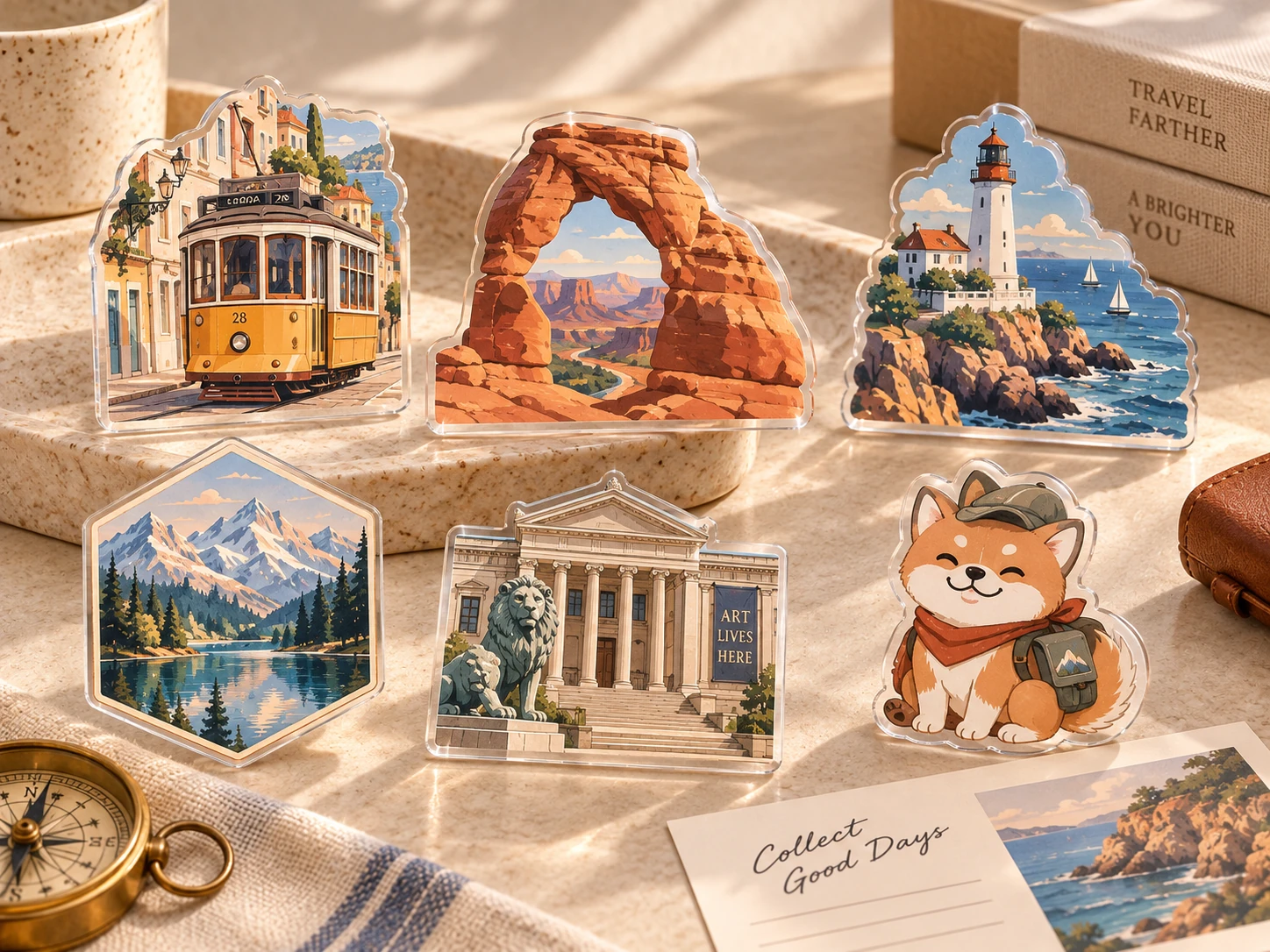
1. Understand the Complete Acrylic Standee
A typical slot-in acrylic standee consists of two main pieces.
Upright panel: The acrylic piece carrying the character, illustration, logo or other printed design. Its lower portion includes a tab intended to connect with the base.
Base: A separate component containing a slot designed to receive the upright panel.
Some standees have multiple upright pieces or a customized printed base. Others have additional decorative parts, layered artwork or different display arrangements.
The buyer should specify the assembled product rather than providing only a character illustration.
Important starting information includes:
- Overall assembled height and width
- Upright acrylic thickness
- Base dimensions and thickness
- Base shape and slot position
- Front-facing direction
- Number of upright components
- Printing configuration
- Retail packaging requirements
The dimensions of the character graphic and the finished acrylic outline may not be identical.
Always ask how the manufacturer calculates the finished product size.
2. Why Base Fit Matters
A standee can have attractive printing and still be unsuitable for sale if it does not assemble correctly.
The bottom tab of the upright must fit the slot in the base.
If the fit is too loose, the upright may wobble, lean or rotate.
If it is too tight, assembly may require excessive force and could damage the acrylic.
A successful fit should allow the intended user to assemble the product without forcing the parts together.
The actual result depends on the tab geometry, slot dimensions, acrylic thickness, cutting process and manufacturing variation.
These variables should be reviewed together.
Do not independently change a tab or slot dimension simply because the adjustment looks more attractive in an artwork file.
Instead, use the manufacturer's approved paired template or request a revised technical drawing.
Questions to ask the supplier
- Are the upright tab and base slot designed as one matched assembly?
- Which actual material thickness is used?
- Has the physical fit been tested?
- Does assembly require unusual force?
- Can the upright be removed without damage?
- Will the standee remain upright during normal intended display use?
There is no universal slot clearance that can be assumed suitable for every manufacturer.
Fit should be assessed on the agreed physical sample.
3. Stability Depends on More Than the Slot
A correctly sized slot does not automatically make a standee stable.
The upright's height, width, shape and weight distribution influence how it stands.
For example, an illustrated character with a large wing or accessory extending to one side may behave differently from a compact, symmetrical logo.
The base footprint and slot location therefore need to support the complete product.
Buyers should pay particular attention to:
Assembled height: Taller displays may introduce different balance considerations.
Outline: Wide accessories and asymmetric silhouettes can change weight distribution.
Base footprint: The dimensions of the base influence how the finished product rests on a surface.
Slot placement: The position should be evaluated alongside the upright geometry.
Multiple pieces: Several uprights need adequate spacing and an agreed front-to-back arrangement.
Before approving production, assemble the sample on a flat surface and confirm that the display is suitable for its intended retail or decorative use.
Do not substitute an attractive digital rendering for a physical stability check.
4. Compare Common Standee Construction Choices
| Construction option | Possible advantage | What buyers should verify |
|---|---|---|
| Single upright with plain base | Straightforward display format | Tab fit, base stability and correct orientation |
| Single upright with printed base | Additional branding or scene detail | Print placement, slot clearance and visible artwork |
| Multiple uprights on one base | Layered character or storytelling display | Spacing, assembly order and stability |
| Custom-shaped base | Stronger thematic presentation | Footprint, cutting quality and support |
| Decorative or specialty acrylic | Distinct visual effects | Material availability, print compatibility and physical samples |
The suitable option depends on the artwork, target audience, merchandising role, material and supplier capability.
A decorative construction should never be approved solely because it looks impressive in a mockup.
For product examples, visit our Custom Acrylic Standees page.
5. Artwork Files: Separate Visual and Physical Information
A manufacturer needs to know both what the standee should look like and how its components should be manufactured.
Depending on the selected production process, the artwork package may include:
- Front artwork
- Back artwork, if required
- White-ink or opacity instructions
- Transparent area references
- Upright cutting contour
- Tab geometry
- Base outline and slot
- Printed base artwork
- Finished dimensions
- Orientation and assembly notes
These elements should remain distinguishable in the supplier-approved files.
A PNG or other raster image may be sufficient for an initial feasibility discussion.
However, the manufacturer may need to create or refine cutting paths, white-ink information and technical assembly details before sampling.
Artwork files should not be described as production-ready merely because they look correct on a screen.
See our related guide: Vector, Raster or 3D? Preparing Artwork Files for Custom Souvenirs.
6. Print Alignment: Keep Artwork and Cutting Contours Consistent
The artwork position must be coordinated with the intended acrylic outline.
A design can look correct as a flat graphic while appearing poorly centered inside the finished cut piece.
Buyers should check:
- Whether the printed design is positioned as intended
- Whether important details are too close to the edge
- Whether the transparent border is consistent with the approved design
- Whether the character has the intended visual balance
- Whether cut lines interfere with text or small features
- Whether the tab or inserted base conceals important artwork
If the design uses edge-to-edge printing, ask the supplier about the required bleed and cutting setup.
Bleed and safety margins vary by manufacturing process and supplier template.
Do not apply one company's bleed measurement as a universal industry rule.
White ink and transparent areas
Clear acrylic can create attractive translucent or transparent effects.
White ink is often used to increase opacity behind printed artwork.
Where a design includes transparent windows, the white-ink mask and printed colour layers must be coordinated.
An incorrect white layer may produce unintended transparent or opaque regions.
Ask the supplier to show these areas in the technical proof and, where important, on a physical sample.
7. Double-Sided Printing Requires Orientation Checks
Double-sided acrylic standees require particular care when artwork contains text, numbers, directional symbols or different front and back designs.
A reversed version of the same graphic may cause lettering to appear mirrored when viewed from the opposite side.
Buyers should confirm whether the requested construction uses:
- The same visible design on both sides
- Mirrored artwork
- Two different designs
- A deliberately transparent reverse
- Another printing arrangement supported by the supplier
Do not assume these options are interchangeable.
Where the two sides differ, supply separately identified front and back artwork.
Review both sides in the correct physical viewing direction.
Check the position of logos, faces, captions and decorative elements relative to the final cutting outline.
The supplier's sample should confirm the appearance after assembly, not only the appearance of individual printed layers.
8. Base Printing Is Part of the Product Design
A printed base can turn a basic standee into a more complete scene.
For example, a museum-themed display might combine an upright architectural illustration with an approved ground graphic or destination name on the base.
However, the inserted upright may partially cover the base artwork.
Important graphics should not be placed where the slot, inserted tab or upright will obscure them.
Buyers should confirm:
- Base artwork orientation
- Position of the slot
- Visibility of text and logos
- Relationship between the upright and base graphics
- Printing on the intended base surface
- Assembly direction
For multi-piece designs, review the completed arrangement as one product.
A digital composition showing several overlapping characters should not be assumed to demonstrate actual physical clearance.
9. Packaging for Retail and International Shipping
Packaging decisions should be made before confirming the quotation.
A standee prepared for a museum shop, an online retail order or a gift set may require different protection and presentation.
Possible packaging arrangements include:
- Individual protective bag
- Suitable protective surface film
- Retail backing card
- Printed sleeve
- Individual retail box
- Protective insert
- Additional cushioning where required
The appropriate option depends on dimensions, finish, retail channel and shipping conditions.
Protect the printed and acrylic surfaces
Where compatible with the selected construction, protective film may reduce the risk of scratches before the customer receives the product.
Some specialty surface treatments may require a different approach.
Confirm whether protective film is applied, which surfaces it covers and when the end customer should remove it.
Keep components properly matched
For products shipped unassembled, the upright and correct base should be packed and identified together.
If several characters use similar base shapes, a clear SKU or assembly identifier may reduce picking errors.
Review the outer packing
Consider movement inside cartons, edge contact, weight, stacking and the risks associated with international handling.
A retail-ready package may still need suitable master-carton protection.
The supplier should recommend packaging appropriate for the specific product and shipment.
Avoid claiming a package is drop-test certified unless an actual test has been agreed and documented.
10. What to Inspect Before Approving a Sample
A production sample should be inspected as a complete assembled product.
Use the following checklist as a starting point.
| Inspection item | Buyer check | Approval question |
|---|---|---|
| Upright outline | Compare cutting shape with approved artwork | Is the silhouette correct? |
| Dimensions | Compare physical measurements with specification | Are dimensions acceptable? |
| Tab and slot | Assemble without excessive force | Does the upright fit correctly? |
| Stability | Place assembled product on a flat surface | Does it stand securely for its intended use? |
| Front printing | Check colour, position and visible detail | Does it match the approved reference? |
| Back printing | Check orientation, text and image alignment | Is the reverse correct? |
| White ink | Inspect opaque and transparent regions | Are effects in the intended locations? |
| Base artwork | Check position and visibility after assembly | Is anything important obscured? |
| Surface condition | Inspect scratches, chips and visible defects | Does it meet the agreed acceptance criteria? |
| Packaging | Check component matching and protection | Will the product be presented and protected appropriately? |
For products involving multiple characters or bases, perform the relevant checks for each distinct construction.
Record the artwork and sample version that is approved.
If changes affect slot fit, thickness, cutting geometry or stability, consider whether a revised physical sample is required.
For further guidance, read the Custom Product Sample Approval Checklist.
11. Compare Supplier Quotations on the Same Specification
Not every acrylic standee quotation includes the same services and components.
Differences may involve:
- Acrylic thickness and material
- Finished dimensions
- Number of upright pieces
- Base size and construction
- Single- or double-sided printing
- Printed base requirements
- White ink and special effects
- Number of designs
- Individual packaging
- Sampling and development work
- Outer packing and shipping arrangements
For example, one quotation may cover a single printed upright and a plain base.
Another may include a printed base, two separate uprights and individual retail packaging.
These should not be evaluated as identical offers.
Request a clearly itemized or otherwise transparent comparison, especially where several construction options are being considered.
MOQ, sampling charges and production timelines are project-specific and should be confirmed rather than estimated from unrelated product listings.
12. A Sample RFQ for Custom Acrylic Standees
Buyers can use the following information when contacting CALDVANE or another sourcing partner.
Project: Custom acrylic character standee collection
Application: Museum shop, destination retail, branded merchandise or e-commerce
Artwork available: Character illustration, logo or reference image
Finished upright size: [Insert dimensions or request recommendation]
Acrylic thickness: [Preferred thickness or supplier recommendation]
Base construction: [Plain, printed or custom-shaped]
Number of uprights: [One or multiple]
Printing: [Single-sided or double-sided]
Front and back artwork: [Same or different]
Transparent areas: [Describe requirements]
Number of designs: [Insert SKU count]
Estimated quantity: [Insert quantity per design]
Packaging: [Protective bag, backing card, retail box or other]
Destination market: [Country or region]
Required schedule: [Target launch or delivery date]
Sample request: Please confirm upright/base fit, stability, print alignment, finish and packaging before bulk production.
Quotation request: Please advise feasible materials, construction options, artwork requirements, MOQ, development or tooling needs, sampling arrangements and project-specific production lead times.
If complete technical artwork is not available, send the reference material and describe what needs to be developed.
A useful initial RFQ makes the project understandable without pretending every production decision is already complete.
Frequently Asked Questions
How should the acrylic standee fit into its base?
The upright tab and base slot should be designed as a matched assembly. The finished piece should insert without excessive force and remain stable during intended use. A physical sample is needed to confirm fit.
Why does my acrylic standee wobble?
Possible causes include loose slot fit, unsuitable tab geometry, insufficient base support or an unbalanced upright shape. The complete assembled product should be evaluated rather than changing the slot independently.
Can acrylic standees have different artwork on each side?
Yes, where supported by the supplier's selected printing process. Provide clearly identified front and back artwork and verify that text, logos and directional details appear correctly when viewed from each side.
Why is white ink used in acrylic standee printing?
White ink can provide opacity behind colour artwork on clear acrylic. Its placement affects the final visible and transparent areas. Ask the manufacturer to confirm the white-ink configuration.
Should acrylic standees be shipped assembled?
Not necessarily. Shipping upright and base separately may be appropriate for some designs and packaging methods. The best approach depends on product geometry, surface protection, retail presentation and shipping requirements.
Can CALDVANE help buyers who only have reference artwork?
CALDVANE can help review available concepts and artwork, evaluate potential product specifications and coordinate suitable supplier development and sampling options. The scope depends on the specific project.
Build a Reliable Acrylic Standee Collection
Acrylic standees can be appealing products for character collections, museum retail programmes, destination souvenirs and branded merchandise.
The challenge is not simply converting an illustration into a printed acrylic shape.
The finished product must have a correctly matched base, stable construction, appropriate printing, accurate artwork orientation and suitable packaging.
For wholesale buyers, these details should be specified before the quotation is finalized and verified through an appropriate sample approval process.
CALDVANE helps overseas B2B buyers source and develop customized acrylic merchandise through specification review, supplier coordination, sampling and production planning in China.
Share your artwork, product dimensions, estimated quantities and packaging requirements to discuss feasible options for your project.